
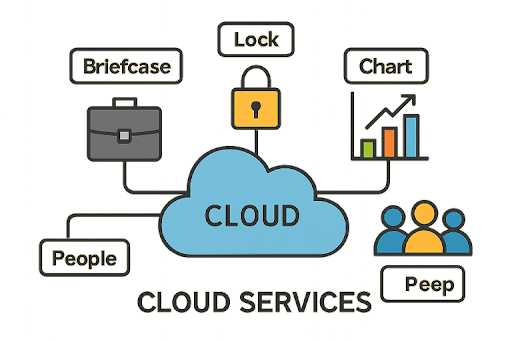
Key Takeaways
- Cloud services enhance operational efficiency by automating routine tasks and enabling real-time collaboration.
- They offer scalability and flexibility, allowing businesses to adapt quickly to changing demands.
- Implementing cloud solutions can lead to significant cost savings and improved data security.
Cloud services are transforming businesses’ operations by delivering enhanced efficiency, cost control, and security. Organizations worldwide have adopted platforms like cloud solutions Microsoft to streamline processes, respond quickly to changing demands, and foster real-time collaboration among globally distributed teams. By leveraging cloud platforms’ scalability and technological innovation, companies no longer have to rely on outdated systems and manual processes that limit business growth and agility.
Enhancing Operational Efficiency
Cloud services streamline business operations by automating routine tasks such as system updates, backups, and security monitoring. Automation eliminates manual errors and allows in-house IT staff to focus on innovation and strategic initiatives instead of day-to-day maintenance. Leading cloud platforms incorporate artificial intelligence (AI) and machine learning to anticipate system issues and offer predictive maintenance, reducing downtime and enhancing operational stability. This level of automation and insight was previously difficult to achieve with traditional on-premises solutions.
Scalability and Flexibility
The scalability provided by cloud services is a game-changer for growing businesses. Companies can scale their computing resources up or down in response to fluctuating demand without investing in costly new hardware. For example, an online retailer can temporarily boost its server capacity during peak holiday shopping seasons to ensure smooth and fast customer experiences. Likewise, cloud flexibility enables organizations to experiment with new applications or services, test solutions in real time, and adapt instantly to market opportunities. This agility can be the key to maintaining a competitive edge in sectors that require rapid adaptation or innovation.
As businesses become more dependent on cloud-based applications and larger amounts of data move between local systems and cloud platforms, the quality of the underlying internet connection can also matter. For organizations that regularly handle large uploads, downloads, or other data-intensive tasks, fiber internet is one connectivity option to consider. Its fiber-optic infrastructure can provide fast connection speeds that support the demands of data-heavy cloud-based work.
Cost Savings
Moving to the cloud can generate significant cost savings for businesses. Cloud providers operate on a pay-as-you-go pricing model, so companies only pay for the storage, computing, and software they use. Mature multi-cloud strategies can reduce enterprise IT expenses by eliminating overprovisioned resources, streamlining management, and avoiding costly infrastructure investments. According to Gartner, organizations are increasingly optimizing cloud expenses and reinvesting savings into innovation and business development, making the transition financially attractive for small and large enterprises.
Improved Data Security
For many organizations, security remains a chief concern when moving to the cloud. However, leading cloud providers deploy advanced security measures that often exceed in-house capabilities. End-to-end encryption, multi-factor authentication, and continuous vulnerability monitoring help protect sensitive business data from emerging cyber threats. Furthermore, cloud platforms make it easier to comply with evolving data protection regulations, providing tools to manage privacy settings, conduct audits, and ensure regulatory readiness. This peace of mind enables organizations to innovate confidently while maintaining strong data security standards.
Real-Time Collaboration
Real-time collaboration is at the heart of cloud benefits, allowing staff to communicate and work together regardless of location. Cloud-based productivity suites, shared project management apps, and instant messaging tools make it easy for remote teams to access critical documents, track progress, and update tasks simultaneously. This fosters a culture of transparency and accountability, helping organizations maximize their talent pool, support remote work models, and respond faster to customer needs. Cloud solutions also break down silos between departments, encouraging knowledge sharing and continuous improvement across the business.
Disaster Recovery and Business Continuity
Business continuity is crucial in today’s unpredictable environment. Managed cloud services offer robust disaster recovery options that safeguard data through automatic backups and geographic redundancy. In a system failure, cyberattack, or natural disaster, companies can restore critical operations with minimal downtime. Comprehensive cloud recovery plans protect against data loss, reduce risk, and ensure that companies remain resilient no matter the challenge. This capability is indispensable for sectors such as healthcare, finance, and e-commerce, where continuous uptime is required by both regulation and customer expectations.
Final Thoughts
Cloud services are foundational to modernizing business operations, driving efficiency, scalability, and security. By transitioning to secure and flexible platforms, organizations safeguard their data, support growth, and prepare for the challenges of tomorrow’s marketplace. As digital transformation accelerates, adopting and optimizing cloud solutions empowers businesses to build resilience, nurture collaboration, and achieve sustainable long-term success.
 MK Digital.co