
Introduction
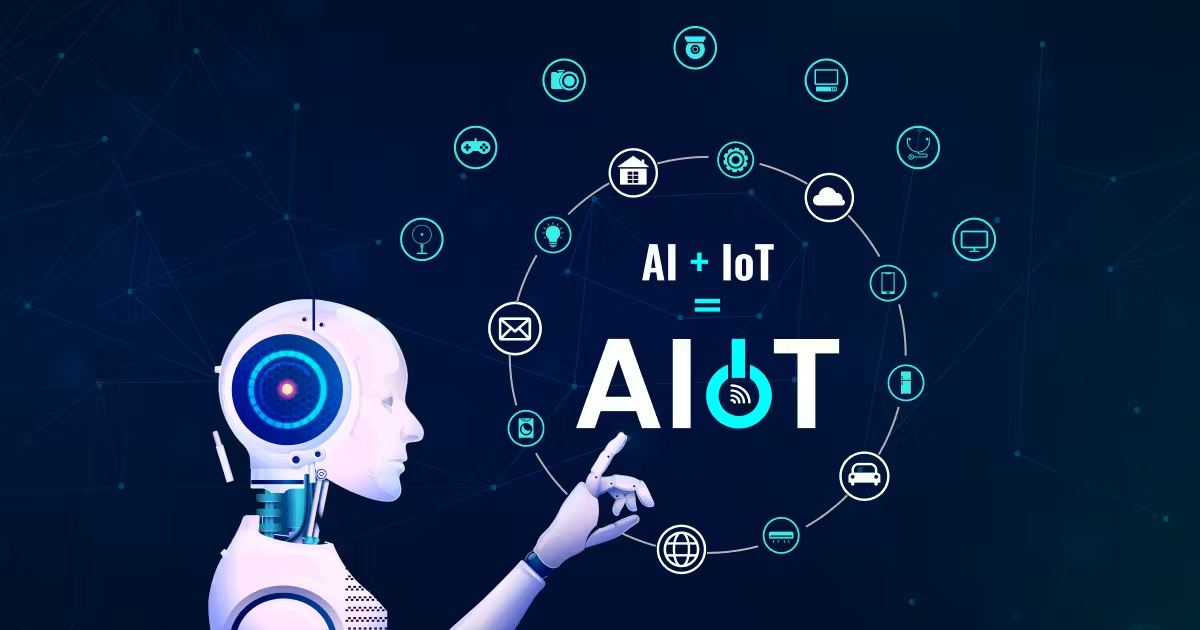
AIoT refers to the concept where artificial intelligence and the internet of things are combined to generate cognitive responses while eliminating the need for oversight. AI is nowadays integrated into IoT devices to enhance their capabilities and minimize the need for human supervision.
More and more corporations are shifting to AIOT for business growth by leveraging the intelligent capabilities into their hardware infrastructure. The growing role of AIoT in various sectors is proven by the reports stating that its global market size in 2023 was $35.65 billion and is anticipated to increase $253.86 billion by 2030.
By integrating AI’s intelligence with IoT’s connectivity, businesses can generate informed, faster, and more precise decisions without relying on expert teams. Real-time data analytics, complete autonomy in regular operations, and an adaptive system are the core strengths of embedding AI into an IoT network. AI is capable of processing immense data in real time, and thus it does the same with information collected by IoT devices, and provides meaningful insights to act upon.
Primarily, IoT was only concerned with collecting data from various sources through its interconnected tools. These networked devices required human oversight to function properly and could not take any action on their own. But the inclusion of AI into the IoT environment not only empowers them to make decisions but also brings adaptive learning over time, allowing independent functioning.
Why AIoT Matters for Modern Businesses
The intersection of IoT with artificial intelligence generates an intelligent system, which is capable of making informed decisions in real time, without depending on experts. AIOT for business growth is the most acknowledged evolution in the modern technical landscape. The unity of both tech solutions offers efficient monitoring and autonomous processes, facilitates rapid decision-making, and continuous improvement in performance.
A single IoT system tends to share data of the incidents or events, after they actually happen, allowing businesses only a reactive response. Whereas, with AI, the devices themselves can think and take appropriate action on time, providing a proactive response to a situation or event. Intelligent devices can locate any potential issue or risk in advance, predict future loss or damage, and prepare for preventive actions. AIoT solutions use their prediction capability to take maintenance and recovery decisions in advance, saving cost and time.
AIOT is increasingly adopted across industries and for domestic use as well in smart cities. The market size of innovative technology is expected to show a CAGR (Compound Annual Growth Rate) of 27.6% between 2024 to 2030. So, the increasing adoption of AIoT among businesses is inevitable. Technologies like natural language processing, machine learning, and cloud computing have been significantly contributing toward the growth and implementation of AIoT. Moreover, generative AI has also been an integral part of technology that brings new and innovative features.
Core Applications of AIoT in Corporate Decision-Making
AIoT execution in the corporate sector is setting new business standards by elevating operational efficiency and enabling real-time informed decision-making. The following are the key applications of AI-driven Internet of Things in various cooperative dimensions:
Real-Time Data Analysis & Predictive Insights
- Leveraging AI algorithms on IoT data for trend forecasting
IoT devices such as sensors and cameras collect and share data of the connected machine/person. Businesses apply AI algorithms and predictive analytics on this raw data to find behavioural patterns and forecast future likelihood.
- Automated anomaly detection for operational efficiency
AIOT-powered instruments run automatic anomaly detections periodically and can trace potential errors or inconsistencies in advance, before they cause significant damage to the business operations.
- Predictive analytics for market demand, supply chain, and resource allocation
Advanced mechanisms of AI-enabled IoT tools enable predictive analytics for market trends and changes in customer preferences based on the collected data. These insights assist managers in anticipating future demand, designing their supply chain network, and allocating resources optimally.
Intelligent Process Automation
- AIoT-enabled automation for repetitive corporate workflows
Industries leverage AIOT for business growth and automate repetitive tasks performed on a regular basis. Self-directed workflow saves a lot of human effort, which can be directed towards more strategic operations.
- Smart resource management and cost optimization
Intelligent devices empowered by the AIOT system offer predictive analytics, which eliminates the operational expenses and wastage of expensive assets by monitoring them in real time. It saves a significant amount of repair and maintenance costs, along with managing valuable resources.
- Machine learning models are improving process accuracy over time
Modern Artificial Intelligence comes with learning models, which enable it to adapt itself as per the latest changes and implement continuous improvements. Thus, AI-enabled IoT devices are capable of tracking inaccuracies and ensuring flawless processing.
Enhanced Risk Assessment & Mitigation
- AIoT-driven early warning systems for operational risks
IoT devices consistently monitor the machinery performance to collect relevant data. This information is then used by the AI system to locate any type of malfunction. AIoT actively warns about future risks and takes proactive action accordingly. For instance, on locating a defect, it automatically schedules repair or replacement.
- Predictive maintenance to avoid costly downtime
AI-powered sensors are capable of detecting even a minor failure in different machine parts, thus enabling a quick repair or change in that section. The core competency of AIoT not only reduces the maintenance cost for the firm but also prevents the chances of big breakdowns.
- Real-time compliance monitoring and alerts
Manual monitoring through connected devices often fails in ensuring regulatory and ethical compliance in the automated processes, but an AIoT-driven workflow eliminates this risk in repetitive operations. It instantly triggers alerts on tracing any kind of ignorance to the predefined structures and rules.
Key Benefits of AIoT for Business Growth
In the digital era, key benefits like increased operational efficiency, informed decision-making, and much more encourage stakeholders to consider AIOT for business growth.
● Faster and more accurate decision-making.
A combination of AI and IoT informs about the market trends, produces data-driven insights, and enables predictive analytics. Business leaders are leveraging AIoT for quick and strategic business decisions that generate measurable value. The solutions provided by cognitive shared devices are mostly free from bias and human errors, ensuring the quality of outcomes.
● Increased operational efficiency and reduced costs.
AI has always enhanced workplace productivity by automating the frequently carried out processes and regular tasks. On the other hand, IoT is a well-known setup for collecting real-time data across multiple business sources. Thus, when these two technologies come together, they prominently increase operational efficiency by minimizing errors or anomalies in the workflow, and hence save a significant amount of money in many ways.
● Improved customer experience through data-driven personalization.
AI-powered devices and gadgets enable personalized interaction with customers, offering individual-based solutions and query resolutions. AIoT is designed to monitor routine tasks and collect crucial data on their taste, preferences, lifestyles, and personal habits. AI assesses this data and assists the businesses in offering more relevant products or services.
● Greater adaptability in dynamic market conditions.
IoT devices are designed to consistently collect data from a real-time business environment and change market dynamics. It enables the AI working mechanism to accurately identify market trends, patterns, opportunities, or threats. It assists the leaders to adapt their operations and business strategies accordingly, and helps them stay competitive in the current dynamic world.
Challenges in Implementing AIoT for Businesses
You will first have to overcome several technical challenges associated with the effective deployment of AIOT for business growth in order to unlock its full potential.
● Data privacy, security, and governance concerns.
AIoT establishes the interconnection between various devices across the firm that helps collect data from multiple sources, raising privacy and security concerns. Weak governance of the data may lead to misuse of sensitive information and create legal issues in some cases. Thus, businesses utilizing AIOT platforms need to implement high-end security measures, encryption models, and authentication programs.
● Integration with legacy systems.
Seamless integration of AIoT with the legacy system is crucial to leverage the relevant benefits to their fullest potential. Different IoT devices function differently as per their distinct design and protocols, thus establishing unity among them is a challenging task. AI algorithms won’t be able to function efficiently as long as legacy systems’ architecture doesn’t align with the new system.
● High initial investment and skilled workforce requirements.
The AIoT model requires extensive training on high-quality datasets, which can eliminate the chance of biased and inaccurate results. At the same time, it is highly important to hire the right IT team for the development of an AIoT solution that can efficiently train the AI model to produce the results aligning with business goals. Moreover, a powerful tech architecture is required to build the software. All these resources require a significant investment, which makes it challenging for some businesses to afford the technology.
AIoT has to manage an immense amount of data generated by IoT devices, while maintaining accuracy and uniformity. Sensors, cameras, and other connected systems regularly collect real-time raw data, which is incomplete many times. Thus, it requires uniform processing for preparing it for AI analytics and drawing meaningful insights.
Real-World Use Cases of AIoT in Businesses
Here are the real-world use cases that encourage the use of AIoT for business growth-
● Manufacturing: Predictive maintenance and process optimization.
IoT devices such as cameras and sensors are placed on the factory site to monitor the performance of machinery in real time. These connected tools provide continuous performance updates and AI analytics performed over this data, which assist in predicting potential failure due to defects and take corrective actions in time. Therefore, the implementation of an AIoT system in the manufacturing industry streamlines tasks like maintenance scheduling and production processes optimization.
● Retail: Personalized recommendations and smart inventory.
AIoT is highly used in the retail industry for collecting data on customer preferences, market trends, and inventory demand, and thus, offering personalised recommendations on social media platforms. Therefore, the AIoT ecosystem provides real-time updates about the current inventory level, while accurately predicting demand and maintaining optimum stock in the warehouse, by placing orders whenever required.
● Finance: Fraud detection and risk scoring.
The finance industry deals with a large volume of monetary data and is sensitive to market changes. AIoT facilitates the study of trends, fluctuations in interest rates, and the risk involved in different portfolios. AI-powered devices collect actionable insights on market trends, customer behaviour, identify anomalies, and thus, detect fraud in real time.
● Logistics: Route optimization and real-time shipment monitoring.
The IoT implementation encourages business owners to install remote devices like cameras and sensors in vehicles. These integrated devices offer real-time information about driver behavior, vehicle performance, speed, traffic conditions, and much more. All this detail is then used by the AI system to navigate the best routes, avoiding traffic and poorly maintained roads. Additionally, AIoT facilitates the seamless communication between the supply network, which allows easy tracking of shipment status as well as remote monitoring.
- AIOT in Healthcare
AIoT in healthcare enables continuous patient monitoring through smart wearables that track vital signs in real time. It supports predictive maintenance of medical equipment, reducing downtime and improving care delivery. Hospitals use AIoT for smart drug dispensing and inventory management. Additionally, IoT Healthcare Solutions enhance remote patient care by integrating IoT devices with AI-driven diagnostics for faster, data-backed decisions.
Partnering with an IoT Development Company for AIoT Success
It is highly important to partner with the right IoT development company in order to leverage the full potential of AIoT for business growth. At A3Logics, we build a comprehensive AIoT system highly customized according to particular business challenges and objectives.
We focus on your goals and pain points to provide you with tailored solutions that can work well with your existing system.
Our company holds years of experience in AI integration, setting secure IoT infrastructure, and delivering real-time analytics platforms.
A3Logics prioritizes scalable performance over time and offers flexible AIoT solutions that can grow with your business needs.
Conclusion
Employing AIOT for business growth impacts corporate decision-making in areas such as production, customer services, routine operations, and resource utilization. Leaders can make strategic choices based on the insights obtained from AI-powered IoT devices.
Introduction of machine learning and human-like intelligence in IoT devices has transformed the digital landscape of collecting and analyzing data. The business world is shifting from manual evaluations based on historical events to more predictive, agile, and data-backed strategies.
As the scope of AIoT is expanding with evolving technologies, it signals towards an optimistic future, empowering cognitive mechanisms and intelligent enterprises. Businesses can gain endless opportunities for growth if they successfully navigate through the associated challenges by joining with the top IoT application development company, like A3Logics.
 MK Digital.co
  IQnewswire